

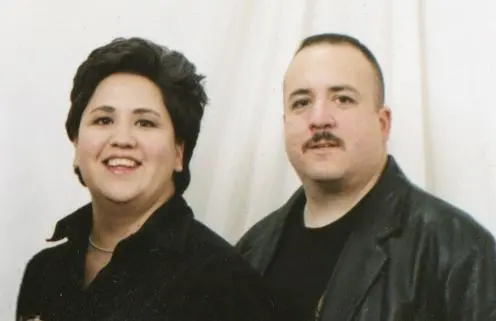
Sister and Brother Carmen and David.
When “Keeping It Together” Becomes Too Much
My Brother David, the Pain We Couldn’t See, and the Cost of Men Suffering in Silence

Sep 19, 2026, 12:35 PM CT
Share


I always loved being near my big brother David because David had the warmest smile, the most welcoming eyes, stood tall and proud to be Mexican, and he was so relaxed that being next to him made me feel at ease. This is exactly what he was like since we were little Southside kids riding together on his banana bike, through our adulthood riding in his Lariat pickup truck together with the windows down through Sherman Park. So, in the months leading up to his lonely and difficult decision that he just couldn’t take living anymore, I could tell something was wrong because his eyes were now sad; he forced his smile when our family got together, he held me longer when we’d say goodbye, and in his hugs I could feel his body was now tense.
As his sister, I saw this, and I would call him daily. I would roll up at his house to say, “David, let’s go pick up the boys (his sons), let’s take your boat out, let’s get some Chinese, let’s listen to some Carlos Santana in your basement together.” I tried to say all the things David liked to do, and he just wasn’t moving. “No, Carm, I’m just gonna stay home and chill on the porch.” “Okay, David, I’ll sit on the porch with you. We don’t even have to talk.” Anything, I thought, to let David know I wanted to stay close to him and he didn’t have to be sad alone because the very words I really wanted to acknowledge were unspoken. “David, I know you’re sad, I know you’re hurting, I know this is the hardest thing you’ve ever had to go through in your entire life, and you’re only 39. But I’m here, David. I’m not going anywhere, David. I’m your ride or die, David; what you feel I feel, David, and I Love you, David.”
You see, my brother David was going through a divorce he did not want, and during his separation, he began a new relationship with a woman who was draining him. You’ve got to understand now, like many Latino and Black men, David defined his worth by devoting his life to being a loving man in a committed relationship; he was hardworking with an important career by day and ran his own company nights and weekends, always made time for parties and for providing for his family and extended family, owned his own home and Ford pickup truck, and was a role model for his sons who were his entire world. So, when he started losing all of those things that made him the man that he was, one right after the other, David began to feel that his life was ending.
Our parents, whom David was very close to and adored, told David to please come home, where they could give him the love and affection and prayers and protection that he needed the most through our Pop’s consejos (advice) and homemade Mexican meals made from scratch by Mom, a foundation where he could lay his head and body to rest when he could no longer sleep because his mind was constantly swirling with dark and lonely thoughts none of us knew he felt, and here he was handling it all on his own. We knew he was really down; you could see it in how he carried himself now, and he was tired–physically exhausted, worn on him like a leather jacket, and he was feeling lost without all those things that made him the incredible and strong man that he once was.
Being a Latino man for David meant you keep it together and you tell yourself over and over, “You better keep it together, man.” Being a Latino man for David meant you don’t express your emotions when things are falling apart, and only accept help over some iced-cold ones from your best friends that you grew from a teenager into a man with – not medicine given to you by a psychiatrist to help you cope, and most certainly not the unspoken: seeing a psychologist or psychotherapist who could save your life. Sadly, though, the message David and many Latino and Black brothers tell themselves is, “Keep it together, man.”
According to the American Institute for Boys and Men:
Men end their lives by suicide at three to four times the rate of women.
In the U.S., a comprehensive study of all individuals who died by suicide between 2003 and 2020 found that among men,one in five suicides occurred in the context of intimate partner problems including breakups, separation, and divorce.
First, it is no secret that relationship breakdown, and particularly maritalseparation, can be a profoundly arresting emotional experience. The end of a relationship can precipitate a cascade of negative emotions.
Shame, in particular, is a common feature on the path to suicide for many men following relationship breakdown. Shame may arise due to the fracturing of men’s sense of worth and socialized masculine roles as fathers and family men, or the exposure of some men’s vulnerabilities or potential failings amid relationship breakdown.
What I want our brothers reading this to know is that you matter to us. You really, truly don’t have to “Keep it together.” People in life love you right where you are, and if you’re going through one of the worst times in your life that you don’t think you’ll ever recover from, please seek help. Tell somebody, “I feel like I’m going to harm myself or somebody, and I need help because this is too much on me.”
There is help in Milwaukee and around the U.S. and I’m starting with 9-8-8 that’s the Suicide Prevention Hotline and if you are a Veteran, press 2.
It is Free, 24/7, confidential support is a call away. The Veterans Crisis Line can help even if you’re not enrolled in VA benefits or health care.
With 9-8-8 you can call, text and you can chat, completely confidential, free of judgement, a counselor will introduce themselves to you and ask if you are safe.
Access Clinics: Offers assessments, counseling, medication evaluation, peer support, referrals, and connections to other services for uninsured and underinsured Milwaukee County residents 18 years old and older.
Milwaukee Health Services Behavioral Health Clinic - 2555 N. Dr. Martin Luther King, Jr. Drive and 8200 W. Silver Spring - call (414) 372- 8080 or walk in
Outreach Community Health Centers - 220 W. Capitol Drive - call (414) 727-6320 or walk in Milwaukee County Health and Human Services Behavioral Health website has so many resources available: county.milwaukee.gov health and human services behavioral health.

Sales Director and Contributing Writer for The Milwaukee Courier
For 30 years, Carmen has been a Sales Professional in the LGBTQ, Latino and Black Press because she believes in the power of building relationships through the "original" media outlet to ignite, engage, inform, educate, entertain and touch the lives of everyone who holds the newspaper with a sense of pride.
Carmen also covers arts and culture, community and history, drawing from her background on Milwaukee's Southside and Sherman Park neighborhoods and four years in Minneapolis where her writing career began. Email Carmen at: [email protected]