

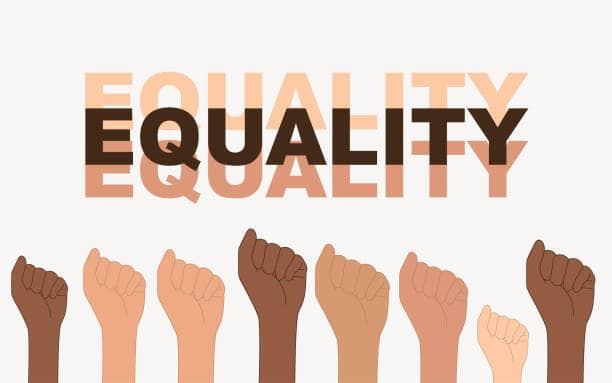
Source: bombuscreative

Sep 4, 2026, 12:12 PM CT
Share


The term “intersectionality” is a gift from the academic gods. It opens up a lane for us to understand how race, gender, class, history, power, and the law can collide, and how those intersections can produce very different experiences for people who are supposedly protected by the very same rights.
Now that I've said it that way, let me say it differently for the folks in the back. When it comes to some laws and some rights, we know Black folks get handled differently. We know it because history tells us so, no matter what misinformation is posted in front of history museums. We know it because statistics tell us so, even though higher education and organizations are being bullied to discount disparities. We know it because we've lived it.
The law may be written in black and white, but its application gets really hazy when the person standing before it is Black. And nowhere is that contradiction more interesting, or more complicated, than when we talk about guns, self-defense, and the concept of stand your ground. Right out of the gate, let me say that I believe in responsible gun ownership in the Black community.
I acknowledge that this conversation usually begins and ends with, “We need to get the guns out of our community.” I understand why people say it, and I understand the fear behind it. But the concept of intersectionality taught me to ask another question: How do we reconcile calls to disarm Black communities when historically, through the use of Black Codes, Black Americans were often denied the right to arm and defend themselves? And truth be told, it still feels like that today.
When a Black person legally owns a firearm and actually uses it to defend himself or herself, we are sometimes confronted with another question: Was it really self-defense? In fact, too often, our claims are dismissed or devalued. As an example, take the case of Keshia Golden, an Illinois Black woman who said she acted in self-defense after being violently attacked by her boyfriend. Initially charged with first-degree murder, she pled guilty to involuntary manslaughter. It was a risk that she wouldn’t be believed and could have spent decades in prison.
Karmelo Anthony (Texas), Marissa Alexander (Florida), and Kevin Epps (California) are other examples of high-profile Stand Your Ground or Castle Doctrine defenses that were not believed. And the list is long. Whether a firearm, another weapon, or, in Trayvon Martin’s case, the sidewalk, fear for Black life just doesn’t seem to be enough. Black fear believability has to take into consideration who had the weapon, who is assaulted, how their actions are perceived, whose fear is considered reasonable, and whose response is considered excessive. And if fear can justify deadly force, whose fear do we believe, and are we judged by the same standards?
And honestly, it’s just getting old. It is exhausting to watch Black people repeatedly have to prove that our fear was real, our intentions were legitimate, and our lives were worth protecting. It is exhausting to watch the same law bend toward empathy for some while skepticism greets others. We know what it feels like to not be believed, to be judged more harshly, and to be afforded less grace. We have seen it too many times, in too many courtrooms, in too many encounters, and in too many headlines. We are not asking for special treatment, just the same treatment. We want the same presumption that our lives matter (sound familiar?). We want the same consideration of our circumstances and the same understanding when we say we were afraid. We need paper rights to match our reality.
Michelle Bryant is host of “Say Something Real with Michelle Bryant,” a morning drive political talk program on WNOV 860AM/106.5FM. She is a political strategist, president of CMB Consulting & Associates, and a weekly columnist for the Milwaukee Courier Newspaper. A former Chief of Staff in the Wisconsin State Legislature—where she also served as Budget and Policy Director and Clerk of the Senate Committee on Judiciary and Public Safety—Bryant brings decades of experience in legislative leadership, campaign management, and public policy. She is a graduate of the University of Wisconsin–Milwaukee and a longtime advocate for civic engagement and equity.