

TWO HARBORS, Minn. — When Melissa Hortman led Minnesota’s House DFL caucus, she kept a file of candidates ranked by how many doors they’d knocked over the last week.
She told people, “This is a list of the people I like and the order I like them in,” recounted Zack Stephenson, who succeeded Hortman after her murder last year.
Carrying on Hortman’s emphasis on door knocking, Stephenson now gets those numbers. “And I like Aaron Schweiger quite a bit,” he said of the DFL candidate for House District 3B.
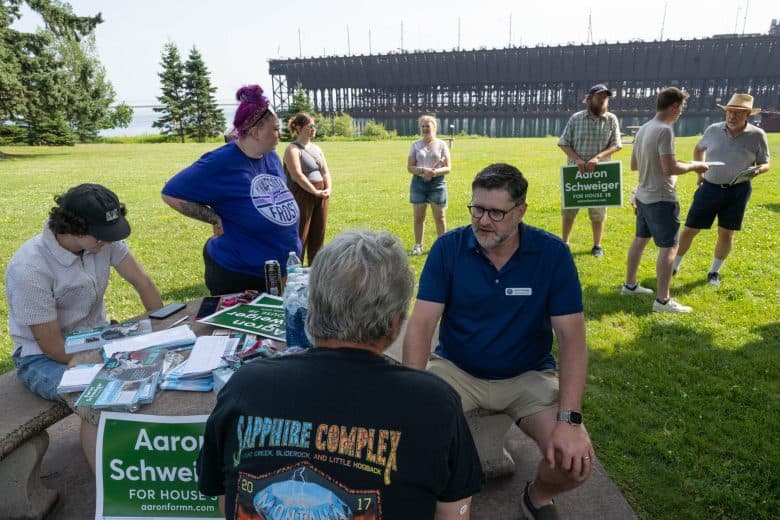
One door at a time, Schweiger is challenging Republican incumbent Natalie Zeleznikar in a district spanning Two Harbors, Hermantown, Proctor and rural areas north of Duluth. He is one of two DFLers looking to unseat House Republicans in the 3rd District, with Aaron Kania facing Rep. Roger Skraba of Ely in 3A.
With an evenly split House going into this fall’s elections, DFL leaders see these northeastern Minnesota races as a chance to seize control.
The district’s DFL senator, Grant Hauschild, said as much while door knocking with Schweiger in Two Harbors in July.
Their work, he told a group of volunteers, could be the difference between a “DFL-run House or a Republican-run House.”

Z for 3B
Zeleznikar has fended off strong DFL opponents before.
Her first win in 2022 represented a break from her district’s established political order. She unseated Mary Murphy of Hermantown, who had represented the area as a Democrat for 46 years, by a mere 33 votes. In 2024, the woman who wears a “Z” necklace won reelection by 159 votes against former judge Mark Munger.
A retired nursing home administrator, Zeleznikar can dive as deep as you’d like into Medicaid payment rates. She says she’s the “only person in the Legislature with the experience of running a 24-hour facility.”
Currently, she’s knee deep into working with providers threatened with Medicaid disenrollment by the state Department of Human Services, scrambling to comply with the Trump administration.
On a muggy afternoon in Duluth, Zeleznikar met with Scott Isaacson, who founded Lift — no, not Lyft — a “nonemergency medical transportation” business ferrying Medicaid patients to and from primary care appointments. The Department of Human Services deemed this type of program “high risk” for fraud.
Thus, Isaacson hasn’t been receiving full reimbursement for his services. Zeleznikar said she’s been in touch with DHS constantly to resolve the problem.
“They need care,” she said of the patients. “They need to get to their appointments. Everybody wants to live in their lifelong home, which is fine, but you can’t have that model without nonemergency transportation.”

A potential wedge issue
Schweiger and his supporters are keenly aware of Zeleznikar’s narrow wins in favorable election years for Republican candidates. This year, he feels the winds are at the DFL Party’s back. Voters are concerned about affordability — whether for housing, prescription drugs or health care — he said.
While Silver Bay isn’t in 3B, patients in the region will lose access to care when a clinic in the North Shore city closes later this year. Democrats tie the closure to federal cuts unleashed by the One Big Beautiful Bill Act, passed by Republicans in Congress and signed by President Donald Trump in 2025.
Schweiger and Kania include health care affordability among their key issues. On housing, the former also touts his experience building affordable workforce housing as the founder of Zenith Asset Management, a residential real estate developer.
“At the end of the day I’m fighting for northland families and for those who are struggling,” he said. “Natalie is fighting for the best interests of big corporations, Wall Street. That’s what this race is coming down to.”
Zeleznikar called his assertion “ridiculous.”
“I am a candidate for the people, working on issues that matter to all,” she said. “Lower property taxes, lower car tabs, bills I authored to help childcare, replacing the 75 year-old airport tower, a second sheet of ice for Hermantown, EMT and CNA training, bringing back strong trade opportunities for students in all schools. And I was selected for the first bipartisan legislative exchange in Minnesota.”
A fresh election issue, however, may allow Schweiger to build his case against his opponent. A group of Hermantown residents are fired up against the city’s data center development backed by Google.
Zeleznikar’s word for her data center stance is “neutral.”
“I want all the information,” she said. “I authored the bill to make elected officials not sign NDAs with data centers.”
Data centers are “all so new, and I think I need time to understand them” and wait for the Hermantown environmental review, she added.
Schweiger, meanwhile, supports local moratoriums and would push for guardrails at the state level to keep data centers from raising utility rates and racking up even more tax breaks. The state already gives tax concessions to qualified data centers on the purchase of equipment like computers and coolers.
But if those measures failed, Schweiger said he’d fight for a state moratorium as a legislator.
Out door knocking, he’s encountered people with anti-data center yard signs who say they voted for Zeleznikar in past elections. Those are the voters he’s looking to pick up this fall.
“With such narrow margins, every vote is going to count,” he said. “When people see the difference on specifically data center issues between myself and Natalie, this is our best chance to flip some votes.”
Kania’s applicable experience
Campaigning in a district bigger than several New England states is unique under normal circumstances, let alone when wildfires are threatening communities within it.
Skraba and Kania have deep connections to Ely, one of the key cities in 3A. The candidates went into fire-response mode for stretches of July as smoke enveloped the town, a launching point for the Boundary Waters Canoe Area Wilderness. They shelved some planned events in favor of attending or convening community meetings to field updates and hear from impacted residents.

Once overnight rain and shifting winds gave the city a reprieve from imminent threats, the two candidates sat for interviews about their race.
Patrons recognized Kania when he walked into Northern Grounds coffee shop. He was the local U.S. Forest Service district ranger until his retirement in late 2025.
Wildfire management was part of his job description, making him acutely aware of the impression a natural disaster can leave on the region.
“Ely is a connected place,” he said. “It’s been helpful to continue those connections and do some brainstorming on who’s impacted by the fires and the closure of the (Boundary Waters) wilderness.”
Kania puts campaign roles in fire management terms. A campaign manager is like an incident commander. Division supervisors are assigned to areas of the district. Teams plan outreach strategies and review actions afterward.
On drives across the district, candidates may hear voter priorities ranging from protecting the Boundary Waters to opening copper-nickel mines to passing gun control to preserving gun rights to funding rural emergency medical services to “just leave me alone.”
On the Boundary Waters and proposals to mine copper and nickel nearby, Kania said a balance is needed between bringing back jobs and ensuring projects cannot impair the wilderness area. Plans need to be transparent and public, and he believes he’s the best candidate to facilitate that process.
“Really it comes down to my ability to talk to everybody that’s interested and find compromise,” he said.
He sees this quality as a point of difference between himself and Skraba, who he said has called environmental concerns stupid and the people who have those concerns “eco nuts.”
“A big part of what I’m learning on the campaign trail and hearing from people is they’re tired of the divisiveness,” Kania said.
Skraba won by only 15 votes in 2022, ending a long run of DFL representatives in his region. His 2024 win was much more comfortable, growing to a 3,664-vote margin.
How can Kania succeed where the last two DFL candidates couldn’t? He noted they lived in International Falls, whereas he’s near the center of 3A near Ely in Tower. Something as simple as being centrally located will help reach more voters on the campaign trail.
He also points to his natural resources background as a good fit for the constituency. In addition, Skraba is running as a Republican in a mid-term election under President Trump.
Many voters answer the door, ask which party the candidate is in, and bring up national issues, Kania said. It can be hard to overcome that and get into local issues.
“It’s Iran and gas prices,” he said. “They’re motivated around that.”

Skraba’s home turf
Skraba met for an interview in Ely’s city hall, where his portrait hangs in a hallway alongside images of fellow mayors throughout the town’s history.
He took a seat and described himself as pro-life, pro-gun and pro-mining. Similar to Jim Oberstar, he added. Skraba once worked for the Iron Range Democrat, the longest tenured member of Congress in Minnesota history.
He also ran twice for the state House as an independent, faring about as well as Republican candidates back when DFL wins were all but a given in northeastern Minnesota.
He still thinks it takes a bit of an independent streak, plus a willingness to work with Hauschild or other Democrats when it’s what’s best for his district, to serve 3A.
“There is a fine line,” he said. “I wish there was an independent Republican Party like we used to have, but I understand why not. If everyone’s an independent, you never get anything done because everyone’s doing their own thing.”
Concerns over copper-nickel mining near the Boundary Waters don’t concern him. After a tour of Eagle Mine, an operation in Upper Michigan used as a model for proposals in Minnesota, he came away trusting that it can be done safely in his district.
“With the technology, with the knowledge, I think we’re ready,” he said. “I truly believe we are ready.”
Mining jobs could loosen the region’s dependence on tourism.
“Everyone’s like tourism’s the way to go, mining’s not, and I’m like, what about now?” he said. “How’s your tourism now? You know, not so good.”
Skraba lives through tourism’s ups and downs as a canoe guide. He said he’d almost always “rather be in the woods,” but also pushes back on the mystique of the Boundary Waters.
“I don’t want to ruin anyone’s day here, but it’s been poked and prodded,” he said of logging and mineral exploration in the wilderness area’s history.
As an Ely native, he grew up legally riding snowmobiles through it, an activity he continued doing even after such usage was banned. “I tell people, how would you feel if I went to your neighborhood and drew a line and said, ‘You can’t drive a car there anymore?’” he said.
After a series of federal wilderness violations in the 1980s and 1990s, he pleaded guilty to driving a snowmobile in the Boundary Waters in 2010. He was Ely’s mayor at the time, although the offense was from three years earlier.
Those days of sticking it to federal rules are behind him, he said.
Still, that history does highlight a juxtaposition in the race. Skraba, who in the past flouted federal wilderness management rules, faces Kania, who enforced federal law as a forest ranger and law enforcement officer.
Nowadays, Skraba said much of his time outside the Capitol is devoted to checking in on local government meetings, touring the state to vet bonding bill requests and keeping up on committee work during and in between sessions. Skraba relishes his Capital Investment Committee work in particular, saying it’s his goal to someday chair it under a Republican House majority.
MinnPost reporter Matthew Blake contributed to this story.