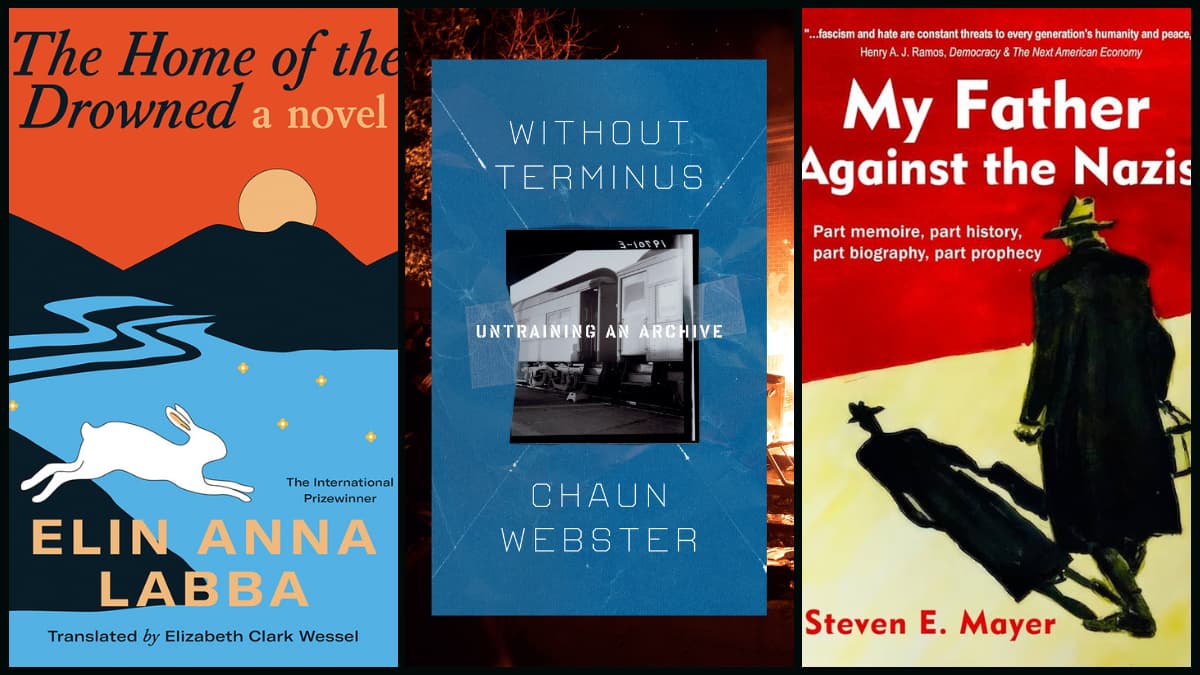


Putting together your summer reading list? Consider three recent books from Minnesota publishers that use literature to confront the limits of the historical record.

In “Without Terminus,” released June 2 by Graywolf Press, Minneapolis-based writer Chaun Webster deconstructs his family’s history and recreates it as luminous, poetic nonfiction.
Using poetry, prose and graphic design, the book investigates the lives of Webster’s grandfather and great-grandfather, who both worked in railroad service. His grandfather, Reginald Jerry Clark, worked for 25 years as a Pullman porter for the Great Northern Railroad, and died before he was able to cash his first pension check. Webster’s great-grandfather, Gerald (Jerry) L. Clark, died of an illness on his way to work as a Red Cap, assisting rail passengers at St. Paul’s Union Depot.
Within the limits of the available historical materials, Webster unravels the impact of white supremacy on the lives of his ancestors. For instance, he analyzes a photograph of his grandfather and considers the exhaustion he likely experienced while working sleeper-car service, where staff were expected to remain available around the clock for white passengers.
He also creates artistic designs using words as a way of teasing out their meaning. In one case, he recreates a headline from what is now the Minnesota Spokesman-Recorder, the state’s oldest Black-owned newspaper, about his great-grandfather’s death: “St. Paul Man Dies After Illness of Short Duration.” Through this design and others, Walker speaks back to the historical record and charts new understandings.

Searching for answers
In “My Father Against the Nazis,” published in 2025 by Edina-based Calumet Editions, Minneapolis writer Steven Mayer uses biography to search for answers to his family’s history.
His father, Paul Adolf Mayer, had just started his career as an attorney in Germany when Adolf Hitler came to power in 1933. He emigrated in 1938 and later joined the U.S. military, serving as a translator. The author’s paternal grandparents died in Auschwitz, a fact that haunted his father and likely contributed to the alcoholism that led to his death in 1984.
Early on in the book, Mayer is in Amsterdam, trying to imagine his father and mother sitting in Café Hulscher in 1936, contemplating where to settle as life deteriorated for Jews in Germany. Frustrated by the limits of hindsight, Mayer reflects on how difficult it is to imagine what his parents could realistically have known in 1936.
“This may be the hardest thing to understand from the vantage point of years later,” he writes. “Paul had thought, deep in his heart, that the Nazi policy of anti-Semitism was simply not directed at him, a German who was Jewish, but a German nonetheless.”
At times, Mayer writes the story of his father like a novel, imagining full scenes with dialogue, like one between his father and grandfather walking around the city of Köln. It follows Paul’s journey throughout World War II and afterward, and perhaps most poignantly, Mayer’s own journey to get to know his father better through writing the book.
Novels as truth
Sámi author Elin Anna Labba’s new novel, “The Home of the Drowned,” published by the University of Minnesota Press, mines family history to reveal truths about Sweden’s treatment of the indigenous Sámi people.

Though a work of fiction, the novel is firmly grounded in the history of Sámi displacement. In a postscript, the author notes how hydroelectric dam projects flooded Sámi villages throughout the 20th century in the area now occupied by Lake Áhkájávrre, one of Sweden’s largest reservoirs.
“Nothing is true, and everything is true;” Labba writes. “Poetry will never hurt more than what has happened.”
The story, translated from Swedish by Elizabeth Clark Wessel, follows three women – two sisters and a daughter – as they endeavor to survive the destruction of their home in the name of progress. Despite fierce love for each other, they don’t always see eye to eye, and each takes her own path to mitigate oppression.
Labba’s beautiful prose – and Wessel’s translation of it – shares truths just as real as those found in nonfiction.
We are living through a challenging period for intellectual inquiry. Reading rates have declined, humanities programs face cuts and closures, and the federal administration has sought to reshape American history, discouraging ideas it deems divisive.
In these moments, rather than accepting historical narratives packaged by those in power, Webster, Mayer, and Labba peel back layers of omission and distortion. Working from archives that are anything but neutral, they model new ways of understanding both history and the present.
Related events:
Graywolf Press and the Loft Literary Center will host a book launch for “Without Terminus” on June 12, 7 p.m. – 9 p.m., at Open Book, 1011 Washington Ave. S., Minneapolis ($10). More information here.